
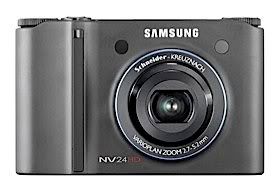
 Compact digital cameras are now a dime a dozen. These cameras must "shout" over each other's heads to get consumers' attention. Samsung's NV24HD digicam has managed to outshout the rest. It is the only one, if not one of the few, that uses the Oled display. Oled or organic light emitting diode is bright enough to be used under harsh sunlight. Its viewing angle is also very wide, so you can easily view many friends for group shots. Running along both the right side and the bottom edge of the 2.5-inch screen are buttons that allow quick selection of settings. That takes a lot of hassle out of photo-taking. Also, these buttons act like a scroll wheel. While previewing my photos, I just swipe my thumb along the bottom row of buttons and the images are scrolled from left to right and vice versa. Taking the pain off mode settings, the NV24HD sports two dials - the usual "mode" dial and the other called "photo style". The second is for special effects selection such as vivid, classic (black and white), retro (sepia tone), calm (diffused color), cool (blue overcast) and forest (good for green foliage). With these two dials, selecting color effect and shoot modes are just a few clicks away. For vibration reduction, it uses what it says is a dual image stabilisation method: it takes two images and merges it to create a blur-free picture. Sounds cool, but it takes too long to process. A "lens shift" based anti-shake solution - shifting the lens to counteract shaking - is still better. Despite all the bells and whistles, one thing that makes or breaks a camera, is its picture output. The NV24HD does not fail in quality. Its 10-megapixel sensor with Schneider lens, at 3.6 times zoom, takes great snapshots. Noise is a letdown, though. Sensor noise or color artefacts are evident even at ISO 400 settings. For the kawk-eyed, some color can also be seen in the shadow areas even at ISO 80 and there is some color smudging, thanks to its overzealous post processing. But irks me most is its less-than-average white balance detection. It fares badly under artificial light, so much so the objects illuminated by an incandescent bulb appear more "yellowish" than they actually are. A quick trip to the white balance settings solves the problems, but using that option would be daunting for the average shooter.


No comments:
Post a Comment
Thank you for commenting on -Chopsticks-, a personal blog that touches on pop culture. Kindly note that I will comment back on your blog (on your latest blog post) as soon as I possibly can, unless I'm not online.
Rules:
1. Kindly avoid promotional/non-sense/unrelated comments as this can be reason for deletion of your comments.
2. Avoid commenting with "nice post"/"thanks for sharing", or the likes. Kindly just read the post and comment something about it.
3. Replying with some facts/rumors or other info related to the post is well appreciated too.
Your comments always make my day(s) feel special and appreciated and each comment will be followed up as well. Thank you and have a wonderful day ahead~